RunLin Wang wrote an article for Forbes titled How To Price Your Product: A Guide To The Van Westendorp Pricing Model.
« First, the following four questions must be posed at the end of the survey:
- At what price would it be so low that you start to question this product’s quality?
- At what price do you think this product is starting to be a bargain?
- At what price does this product begin to seem expensive?
- At what price is this product too expensive? »
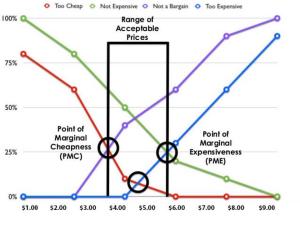
« After results from this survey are collected, they should be visualized on a line graph with price on the x-axis and the number of respondents on the y-axis. »
« The intersection of the number of people who think that the product is “too cheap” and “not a bargain” is the Point of Marginal Cheapness… and so this point acts as a lower bound of acceptable prices. »
« Similarly, the intersection of the “too expensive” and “not expensive” lines is the Point of Marginal Expensiveness, which acts as an upper bound of potential prices. »
« Additionally, the intersection of the “too cheap” and “too expensive” lines is called the Optimum Price Point (OPP). »
Limitations
- « the entire methodology assumes that the surveyed individuals have some sense of what the product or service is worth. »
- « only gauges consumer sentiment without considering fixed and variable costs. »
- « does not take into account potential responses from competitors. »

 Articles of Interest